
C++ while Loop
The syntax of a while loop is:
while (testExpression)
{
     // codes
}
where, testExpression is checked on each entry of the while loop.
How while loop works?
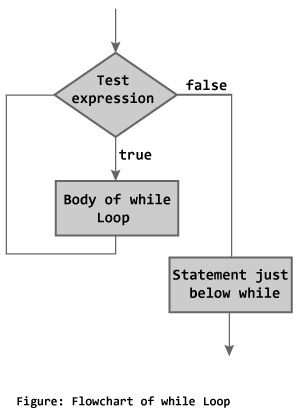
- The while loop evaluates the test expression.
- If the test expression is true, codes inside the body of while loop is evaluated.
- Then, the test expression is evaluated again. This process goes on until the test expression is false.
- When the test expression is false, while loop is terminated.
Flowchart of while Loop
Program 1: C++ while Loop
// C++ Program to compute factorial of a number
// Factorial of n = 1*2*3...*n

#include <iostream>
using namespace std;

int main()
{
    int number, i = 1, factorial = 1;

    cout << "Enter a positive integer: ";
    cin >> number;

    while ( i <= number) {
        factorial *= i;      //factorial = factorial * i;
        ++i;
    }

    cout<<"Factorial of "<< number <<" = "<< factorial;
    return 0;
}
Output
Enter a positive integer: 4
Factorial of 4 = 24
In this program, user is asked to enter a positive integer which is stored in variable number. Let’s suppose, user entered 4.
Then, the while loop starts executing the code. Here’s how while loop works:
- Initially,
i = 1, test expressioni <= numberis true and factorial becomes 1. - Variable i is updated to 2, test expression is
true, factorial becomes 2. - Variable i is updated to 3, test expression is
true, factorial becomes 6. - Variable i is updated to 4, test expression is
true, factorial becomes 24. - Variable i is updated to 5, test expression is
falseand while loop is terminated.
C++ do…while Loop
The do…while loop is a variant of the while loop with one important difference. The body of do…while loop is executed once before the test expression is checked.
The syntax of do..while loop is:
do {
   // codes;
}
while (testExpression);
How do…while loop works?
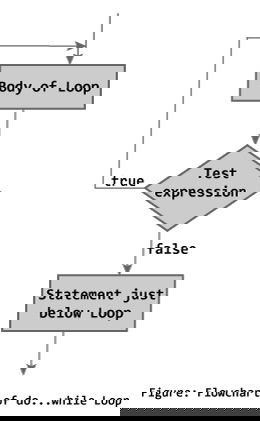
- The codes inside the body of loop is executed at least once. Then, only the test expression is checked.
- If the test expression is true, the body of loop is executed. This process continues until the test expression becomes false.
- When the test expression is false, do…while loop is terminated.
Flowchart of do…while Loop
Program 2: C++ do…while Loop
// C++ program to add numbers until user enters 0

#include <iostream>
using namespace std;

int main()
{
    float number, sum = 0.0;

    do {
        cout<<"Enter a number: ";
        cin>>number;
        sum += number;
    }
    while(number != 0.0);

    cout<<"Total sum = "<<sum;

    return 0;
}
Output
Enter a number: 2
Enter a number: 3
Enter a number: 4
Enter a number: -4
Enter a number: 2
Enter a number: 4.4
Enter a number: 2
Enter a number: 0
C++ for Loop Syntax
for(initializationStatement; testExpression; updateStatement) {
    // codes
}
where, only testExpression is mandatory.
How for loop works?
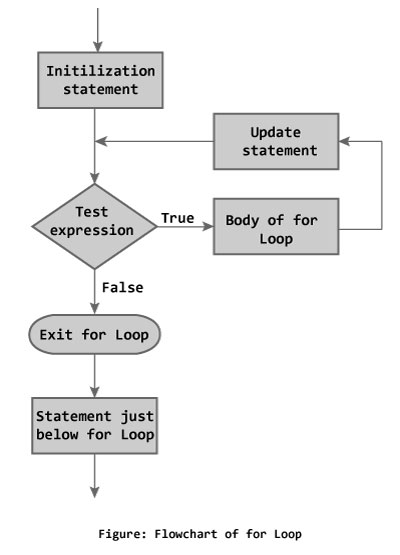
- The initialization statement is executed only once at the beginning.
- Then, the test expression is evaluated.
- If the test expression is false, for loop is terminated. But if the test expression is true, codes inside body of
forloop is executed and update expression is updated. - Again, the test expression is evaluated and this process repeats until the test expression is false.
Flowchart of for Loop in C++
Program 3: C++ for Loop
// C++ Program to find factorial of a number
// Factorial on n = 1*2*3*...*n

#include <iostream>
using namespace std;

int main()
{
    int i, n, factorial = 1;

    cout << "Enter a positive integer: ";
    cin >> n;

    for (i = 1; i <= n; ++i) {
        factorial *= i;   // factorial = factorial * i;
    }

    cout<< "Factorial of "<<n<<" = "<<factorial;
    return 0;
}
Output
Enter a positive integer: 5
Factorial of 5 = 120
In the program, user is asked to enter a positive integer which is stored in variable n(suppose user entered 5). Here is the working of for loop:
- Initially, i is equal to 1, test expression is true, factorial becomes 1.
- i is updated to 2, test expression is true, factorial becomes 2.
- i is updated to 3, test expression is true, factorial becomes 6.
- i is updated to 4, test expression is true, factorial becomes 24.
- i is updated to 5, test expression is true, factorial becomes 120.
- i is updated to 6, test expression is false,
forloop is terminated.
In the above program, variable i is not used outside of the for loop. In such cases, it is better to declare the variable in for loop (at initialization statement).
#include <iostream>
using namespace std;

int main()
{
    int n, factorial = 1;

    cout << "Enter a positive integer: ";
    cin >> n;

    for (int i = 1; i <= n; ++i) {
        factorial *= i;   // factorial = factorial * i;
    }

    cout<< "Factorial of "<<n<<" = "<<factorial;
    return 0;
}
 C++ Programming Language